

How the exam works:
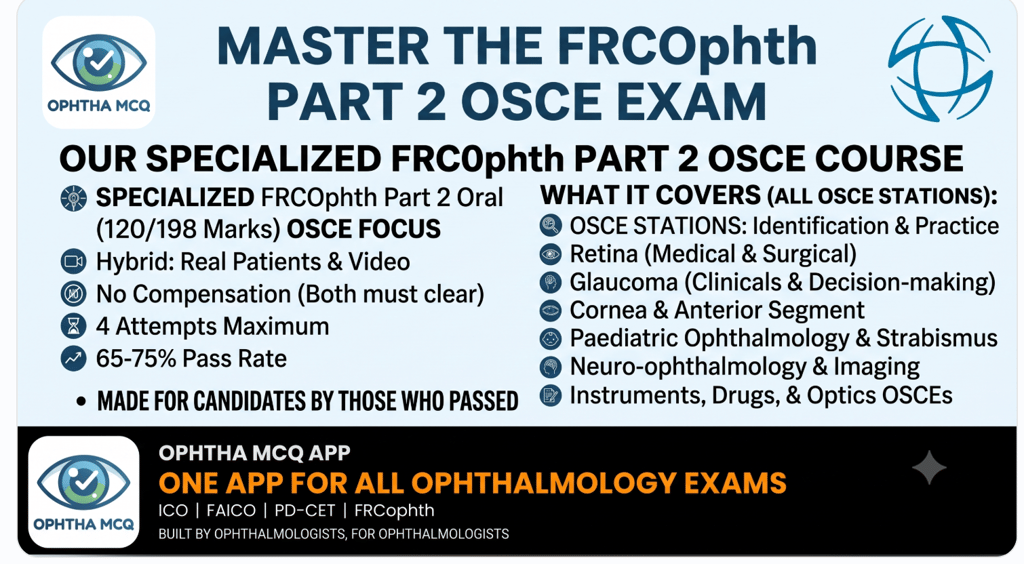
FRCOphth Part 2 Oral consists of a Structured Viva (5 stations, 120 marks) and an OSCE (6 stations, 198 marks, including a communication station)
Runs as a hybrid format — real patients combined with video-based stations
Assessed independently — you must clear both components, no compensation between them
Maximum of 4 attempts allowed
Overall pass rate typically runs 65–75%
Why this matters:
The exam is unforgiving — tested at the bedside, in real time, no room to bluff
Most candidates walk in under-prepared for exactly the stations that catch people out — this bank fixes that
What it covers:
Retina — medical and surgical retina cases, image-led diagnosis and management
Glaucoma — clinical scenarios, investigations, and treatment decision-making
Cornea — anterior segment pathology and surgical case discussions
Paediatric Ophthalmology — strabismus, amblyopia, and paediatric clinical scenarios
Neuro-ophthalmology — visual pathway, cranial nerve, and neuro-imaging cases
Oculoplasty & Orbit — lids, lacrimal, and orbital pathology stations
Uveitis — inflammatory eye disease workups and management
Instruments OSCE — identification and clinical use of ophthalmic instruments
Drugs/Pharmacology OSCE — ocular pharmacology, dosing, and mechanism-based questions
Optics OSCE — refraction, optical principles, and calculation-based stations