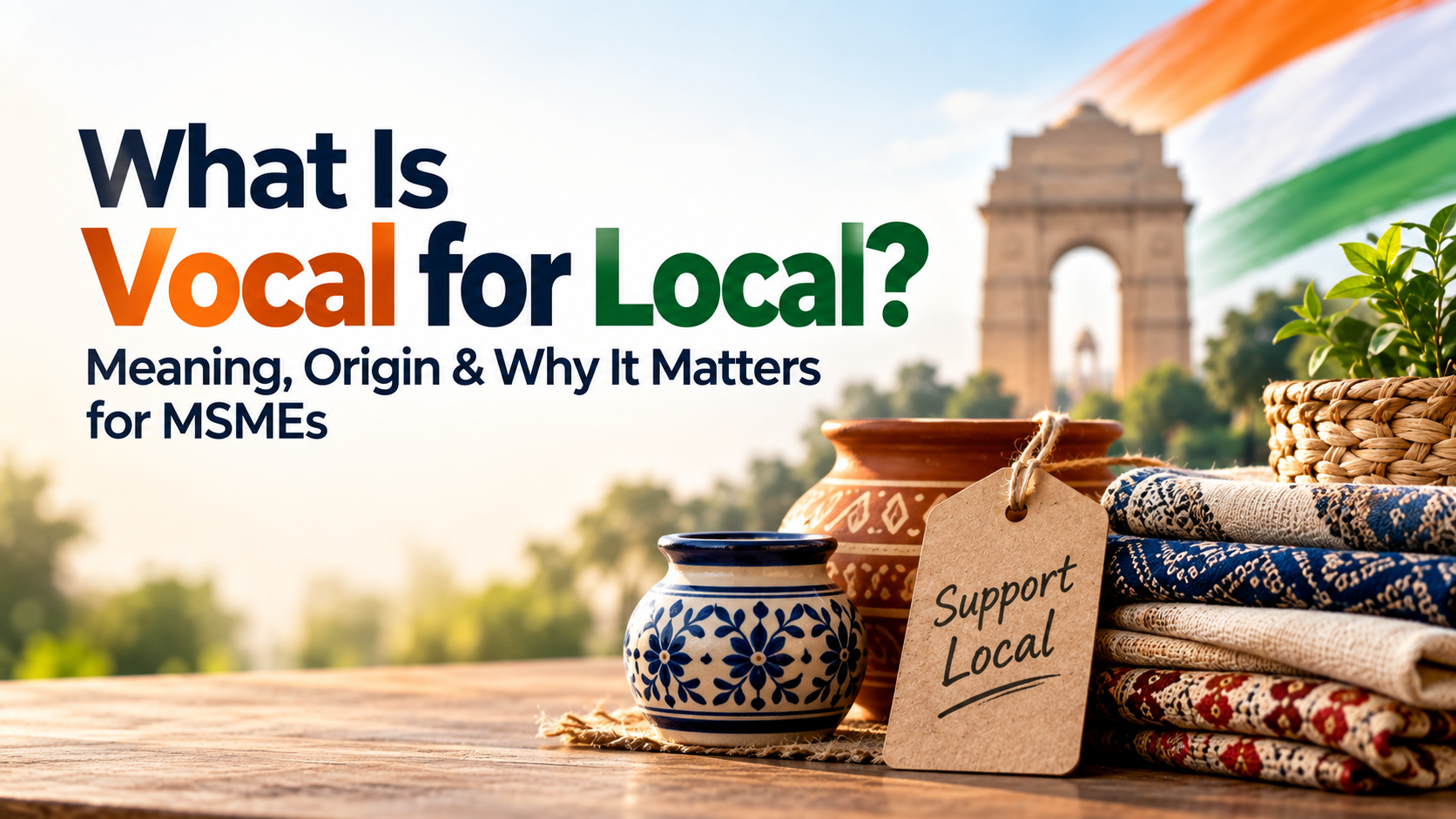
What Is Vocal for Local? Meaning, Origin & Why It Matters for MSMEs
Vocal for Local means choosing Indian-made products over imported ones, especially goods made by small businesses and artisans. PM Modi introduced the phrase on 12 May 2020, as part of the Atmanirbhar Bharat (self-reliant India) push during the COVID-19 crisis. It's not just a slogan; it's a daily choice that keeps money, jobs, and skills inside the country.
What Does "Vocal for Local" Mean?
At its core, Vocal for Local asks Indians to speak up for and buy homegrown products instead of defaulting to foreign brands. The word "vocal" is deliberate; it's not enough to quietly prefer local goods. The idea is to talk about them, recommend them, and make them the obvious first choice while shopping.
The campaign covers everything from handloom sarees and pottery to electronics, food products, and packaged goods made by Indian MSMEs (Micro, Small, and Medium Enterprises). It sits under the wider Atmanirbhar Bharat (self-reliant India) umbrella, which focuses on building India's own manufacturing and supply chain strength rather than depending on imports.
Who Started the Vocal for Local Campaign?
Prime Minister Narendra Modi coined the phrase during his televised address to the nation on 12 May 2020, while announcing a ₹20 lakh crore economic package in response to the COVID-19 pandemic. In that speech, he said it was time to become "vocal for our local products and make them global," tying the idea directly to the five pillars of Atmanirbhar Bharat: economy, infrastructure, technology-driven systems, demography, and demand. He has repeated the call in later Mann Ki Baat addresses and Independence Day speeches, often linking it to festive-season shopping.
Why Did PM Modi Launch the Vocal for Local Initiative?
The campaign was born out of necessity. When the COVID-19 lockdown disrupted global supply chains in 2020, India's local suppliers, from farmers to small manufacturers, kept meeting domestic demand while imports stalled. PM Modi pointed to this directly in his address, noting that local businesses had stepped up during the crisis when the country needed them most.
The government also saw this as a chance to fix a long-standing gap: India was producing very little of certain essentials before the pandemic. In his speech, PM Modi mentioned that the country made almost no PPE kits and very few N95 masks before COVID-19 and, within months, had scaled up to producing lakhs of both daily. That shift showed what local manufacturing could achieve when consumers and industry backed it together.
So the reasoning wasn't only about reducing import bills. It was about proving that Indian workers, artisans, and small manufacturers already had the capability; they just needed consumers to choose them first and infrastructure and credit support to scale up.
How Does Vocal for Local Support MSMEs and Small Businesses?
MSMEs are the biggest beneficiaries of this campaign, and the reasoning is straightforward: they're the segment most exposed to competition from cheaper imports and the segment with the least marketing budget to compete for consumer attention. When shoppers actively choose local, that demand flows directly into MSME order books, workshop floors, and family incomes.
What Are MSME Products?
MSME products are goods manufactured by businesses classified as Micro, Small, or Medium Enterprises under India's MSMED Act, 2006. As of the revised classification effective 1 April 2025, a business qualifies based on both its investment in plant and machinery and its annual turnover:
This covers an enormous range, a two-person handicraft unit in a village, a mid-sized garment exporter, or a regional food-processing brand can all be MSMEs. What they share is being closer to the ground: local raw materials, local labor, and often decades of craft knowledge passed down within a community.
Why MSMEs Need Consumer Support
MSMEs today account for a significant share of India's economy, official government data places their contribution at over 31% of GDP and around 48% of the country's exports, with tens of crores of people employed across the sector. Yet individual MSMEs rarely have the advertising reach of large national or global brands. A consumer who takes ten extra seconds to check "who made this" before buying is doing more for a local weaver or a small food-processing unit than any subsidy alone can.
What Are the Benefits of Buying Local Indian Products?
Choosing local isn't just a patriotic gesture, it comes with practical upsides for both the buyer and the wider economy:
- Money stays in the local economy. Every rupee spent on an MSME product circulates through Indian wages, raw material suppliers, and local logistics rather than flowing abroad.
- Jobs and livelihoods get protected. MSMEs are among the largest employers in the country, especially in tier-2 and tier-3 towns and rural areas where large corporate jobs are scarce.
- You often get more customization and craftsmanship. Local artisans and small manufacturers can adapt products to regional tastes, sizes, and preferences in ways mass-market imports can't.
- Shorter supply chains mean fresher, more traceable goods, particularly true for food, spices, and handloom textiles.
- It builds resilience. The COVID-19 disruption showed what happens when a country depends heavily on imported essentials; a strong domestic MSME base is a buffer against future shocks.
- It supports India's export ambitions. A stronger domestic MSME sector, backed by local demand, is better placed to compete and export globally, turning "local" into "global," which is exactly the phrase PM Modi used at launch.
How Can You Practice Vocal for Local While Shopping Online?
Practicing Vocal for Local Online just means adding one extra check before you complete a purchase: Is this made in India, and is it from a genuine MSME or Indian brand? A few habits make this easy:
- Check the product description or seller page for "Made in India" or manufacturing location details.
- Look for MSME or Udyam registration mentions on the brand's website; genuine small businesses usually display this.
- Prefer platforms and marketplaces that specifically curate Indian and MSME sellers, rather than mixed marketplaces where the origin isn't always clear.
- Read seller "About Us" sections; real local brands usually talk about their artisans, workshop, or founding story in specific detail, not generic marketing language.
How to Identify Genuine Indian and MSME Brands
Genuine local brands tend to be transparent about where and how their products are made. Look for a specific city, state, or cluster mentioned (like Kannauj for perfumes or Moradabad for metalware), real contact details, GST registration, and, where applicable, a Udyam registration number. If a listing only shows a generic "imported" tag or gives vague sourcing information, it's worth a second look before assuming it's a local product.
Shop Vocal for Local Products on ZillyBuy NavBharat
ZillyBuy NavBharat is built around this exact idea, a marketplace where you can shop for swadeshi products online without having to dig through listings to figure out what's genuinely Indian. Every product is sourced with MSME and local manufacturing in focus, from everyday household goods to regional specialties, so choosing local doesn't mean extra effort on your part. If you're trying to be consistent about the best quality products made closer to home, this is a straightforward way to do it: browse by category, check the seller details, and buy knowing your money is going toward an Indian business.
FAQs
Q1: What is the meaning of "vocal" for "local"?
Vocal for Local means actively choosing and promoting Indian-made products over imported alternatives, especially those made by small and medium businesses, artisans, and local manufacturers.
Q2: Is "vocal for local" the same as "make in India"?
They're related but not identical. Make in India (launched in 2014) focuses on attracting manufacturing and investment into India, largely from an industry and policy angle. Vocal for Local, introduced in 2020 under Atmanirbhar Bharat, is more consumer-facing; it asks individual buyers to actively choose Indian products in their everyday shopping.
Q3: What qualifies as an MSME product in India?
A product qualifies as an MSME product if it's manufactured by a business classified as micro, small, or medium under the MSMED Act, 2006. As of April 2025, this is based on investment in plant and machinery (up to ₹2.5 crore for micro, ₹25 crore for small, and ₹125 crore for medium) combined with annual turnover limits (up to ₹10 crore, ₹100 crore, and ₹500 crore, respectively).
Q4: Why did PM Modi start the vocal for the local campaign?
He launched it on 12 May 2020 during the COVID-19 pandemic as part of the ₹20 lakh crore Atmanirbhar Bharat economic package. The goal was to encourage Indians to support local suppliers and manufacturers who had kept the country running during the crisis and to build long-term self-reliance in manufacturing.
Q5: Where can I buy MSME and local Indian products online?
Platforms like ZillyBuy NavBharat are built specifically around sourcing from Indian MSMEs and local manufacturers, making it easier to shop Vocal for Local without having to verify every seller yourself.